
More than 50 contributions across two days in Timișoara explored how we can design resilient work systems while preserving people’s skills, judgement and influence over their work.
The fourth International Biennial Conference of the ErgoWork Society took place in Timișoara on 12–13 November 2026 under the theme “Ergonomics for Mind and Machine — Shaping Resilient Work Systems.” The programme featured more than 50 contributions across plenary talks, in-person and online paper sessions, and a poster exhibition. mpt.upt.ro
The conference brought the principles of Industry 5.0 — human centricity, sustainability and resilience — into a practical discussion about how we organise work with AI. The opening workshop at GreenForest asked which activities people should continue to do, even when AI can do them faster, because those activities help them develop skills, exercise judgement and shape the outcome. The following day at Politehnica University of Timișoara, Professor Stelian Brad made that connection explicit: when comparing ways of sharing work between people and AI, organisations can weigh expected returns alongside system resilience and the ability of people to remain in control.
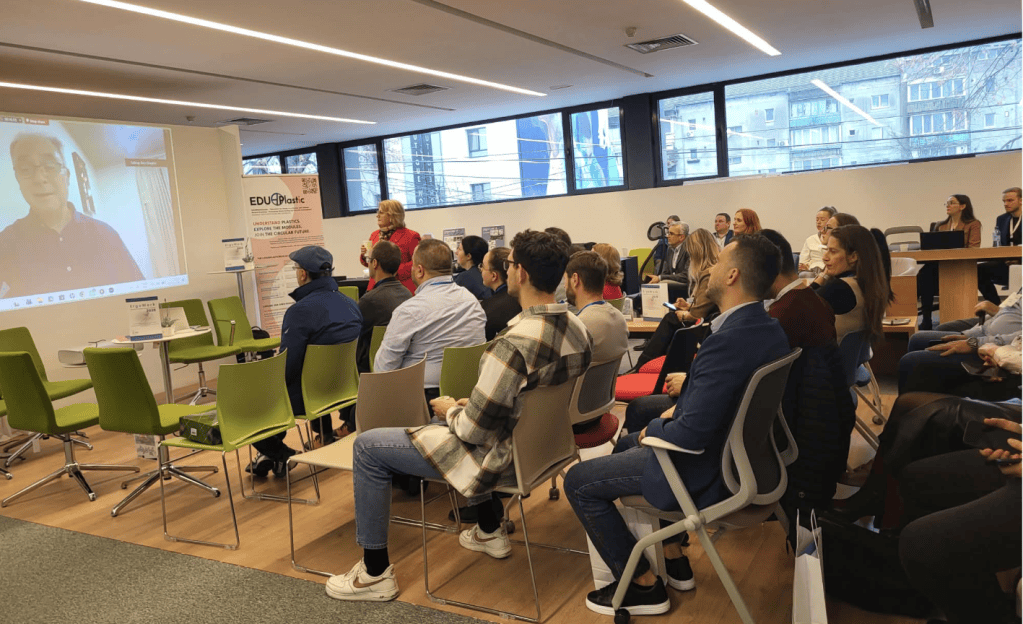
[Photo 1 — Opening at GreenForest: use a wide shot of the opening session or the audience. Caption: “ErgoWork 2026 opened at GreenForest Hall in Timișoara on 12 November.”]
Day one at GreenForest: What should we delegate to AI?
Professor Anca Drăghici, President of the ErgoWork Society and of the Federation of European Ergonomics Societies (FEES), set out the conference theme at the opening. Professor Andrew Thatcher, President of the International Ergonomics Association (IEA), addressed participants by video. Jasna Leder Horina brought a message from the European ergonomics community, and Professor Aleksandar Zunjić of the University of Belgrade spoke on The Role of Ergonomics in Society. mpt.upt.ro
Professor Gyula Szabó’s talk, Prevention Before Intervention: An Ergonomics Perspective on Mental Health at Work, connected the opening to the EU-OSHA Healthy Workplaces campaign “Together for Mental Health at Work.” The prevention perspective framed a practical question for employers: when a new technology changes workloads, responsibilities and the ability to intervene, how can organisations address those risks while they are still designing the work? The opening also featured VirtualEDU, presented by Maria-Elena Boatcă, a project supporting remote ergonomics education for trainers, workers and managers. mpt.upt.ro
Designing Work with AI for Human Capability and Meaning
Moderated by Sebastian Capotescu, the workshop brought together Alin Găureanu, Anamaria Andreea Anghel, Alexandra Mălăieș, Raluca Cibu Buzac, Cristian Neculiță and Christian von Albrichsfeld. Their perspectives ranged from engineering and architecture education to corporate teams, facility and workplace management, research on consciousness and industrial leadership.
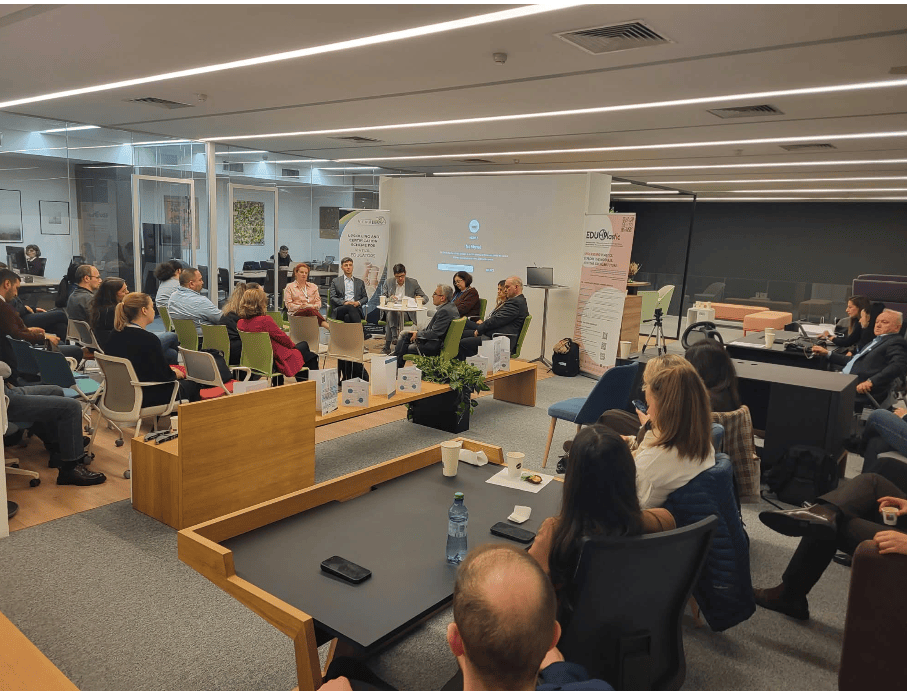
[Photo 2 — GreenForest panel: use a wide photo that shows the panellists and moderator. Caption: “The opening panel brought together academic and industry perspectives on how people and AI share work and decisions.”]
The starting point was a classroom exercise with questionnaire responses from 103 students across interior design and three engineering management cohorts. Students compared human-led, AI-led and mixed approaches at four stages of a workflow: analysis, conception, development and decision. They considered what each arrangement meant for developing skills, protecting professional competence and the quality of the work, retaining control over decisions, and recognising their own contribution.
The architecture examples brought out a distinction between the quality of the output and the experience of doing the work. Students reported greater satisfaction when they could concentrate and develop a project themselves than when AI generated alternatives and recommended a direction. At the same time, Andreea Anghel’s qualitative assessment found stronger examples among projects produced in the mixed mode. The two observations can coexist: AI collaboration can improve the result, while certain parts of the process remain valuable for what students learn and experience by doing them. Alin Găureanu brought the engineering management perspective. The electrical engineering management cohort, which received a more detailed briefing, showed more pronounced differences between its ratings of the three modes. This raises a useful question about how the exercise is framed, without establishing that the briefing caused the difference.
The discussion then moved to what happens in organisations. Christian von Albrichsfeld brought the perspective of industrial leadership: productivity and cost matter, and so do the ability to develop talent and the resilience of the organisation if a system fails or gives poor advice. Alexandra Mălăieș brought the perspective of corporate teams, where the benefits of faster execution depend in part on what happens to the time saved and whether people still have room to learn, collaborate and influence decisions. Cristian Neculiță brought the perspective of facility management, where system recommendations must be weighed against conditions on the ground. A question cut across these perspectives: if people retain professional or legal responsibility, do they also have the competence, information, time and authority to exercise it?
At the level of individual work, the panel also explored the potential of a personal digital twin to adapt support to the person and the task. Raluca Cibu Buzac brought a complementary perspective from her work on consciousness and innovation. She argued that current language models lack consciousness and cognition in the human sense and questioned their ability to originate significant innovations on their own. Her contribution prompted a closer look at what people bring to a decision through lived experience, perception and judgement, and at what makes a result feel like something they helped create.
In parallel, Violeta-Maria Firescu and Živilė Stankevičiūtė chaired an online session on human-centred and resilient work systems, corporate health and occupational risks. Stankevičiūtė examined how work, the workforce and the workplace can be designed together, while Rafael Piacenti addressed leadership in corporate health and ergonomics. The papers covered subjects including psychosocial safety climate, heat exposure, musculoskeletal symptoms, technostress and visual fatigue. mpt.upt.ro
Day two at UPT: From workshop questions to research methods
The second day at the Politehnica University of Timișoara Conference Centre showed how research can make the choices discussed at GreenForest more concrete. mpt.upt.ro
In From Intelligent Ergonomics to Ergonomic Intelligence: Rethinking Human Work in the Age of AI, Professor Stelian Brad, from the Technical University of Cluj-Napoca, presented applied research using Pareto optimisation to compare ways of allocating work between people and AI. The approach brought simulations of return on investment together with measures of resilience and the retention of human control. That was a direct link back to the previous evening: an arrangement that looks attractive on cost and speed can leave an organisation exposed if people lose the ability to understand the system and intervene. Brad also linked the continuing need for human judgement to the limits of current large language models. mpt.upt.ro
Professor Jörg Niemann, from Düsseldorf University of Applied Sciences, examined the problem from the perspective of cognitive ergonomics. His research on how key performance indicators are displayed used eye tracking to help distinguish what people look at from what they actually process and understand. For someone supervising a complex system, registering a change on a dashboard is only the first step. The interface also has to help that person interpret the change and recognise when action is needed. mpt.upt.ro
Associate Professor Jasna Leder Horina, from the University of Zagreb, brought the physical dimensions of ergonomics into focus through studies of posture, musculoskeletal demands and transport safety. Her examples ranged from footwear and the interaction between the sole and the foot to train cabs and the relationship between motorcycles and their riders. Each showed why the fit between people, equipment and the task matters. mpt.upt.ro
The second plenary moved from transport and industry into healthcare, design education and immersive technology. Professor Lăcrămioara Stoicu-Tivadar examined AI applications in medicine and the interfaces through which people interact with digital health systems. Associate Professor Anamaria Andreea Anghel presented projects in multifunctional interior design and showed how examples from professional practice informed courses, studio assignments and student work. In the final plenary talk, Immersive Calm, Dr Laria-Maria Trușculescu explored virtual reality as a non-pharmacological aid, offering a concrete example of how immersive technology can support people. mpt.upt.ro
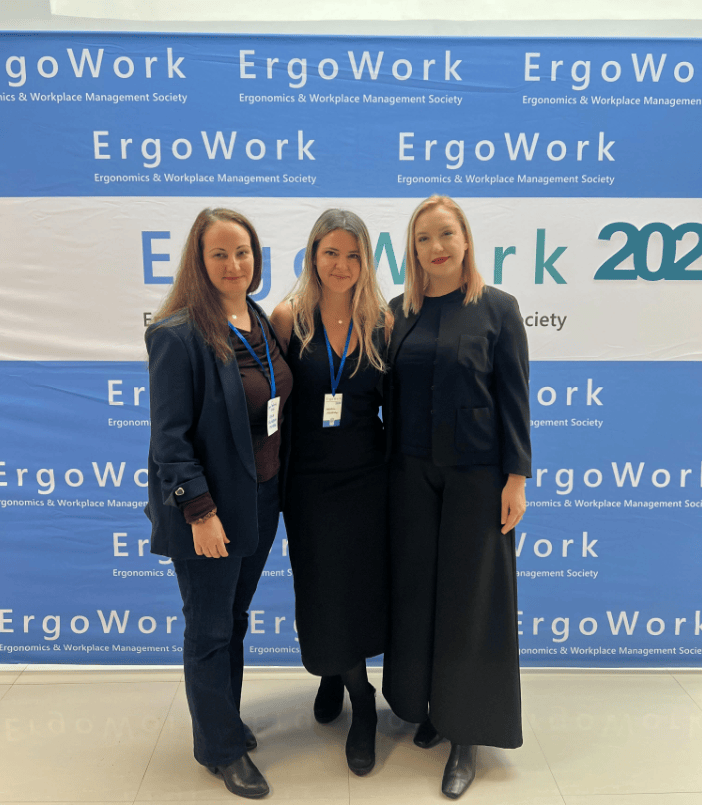
[Photo 4 — UPT: use the photograph of Andreea Anghel and Irina Sălăgean-Mohora by the ErgoWork display. Caption: “Anamaria Andreea Anghel and Irina Sălăgean-Mohora at ErgoWork 2026, Politehnica University of Timișoara.”]
Four themes across the research programme
The ErgoWork 2026 Topic Map groups selected contributions into four themes. Together, they show how the questions raised in the workshop and plenaries played out in specific research projects:
- Core ergonomics and workplace design. Contributions examined the design of community spaces, ergonomic exposure in made-to-order furniture production, and how engineering organisations preserve practical knowledge on complex projects.
- Smart systems and biomechanics. Research explored how to plan measurements for human–robot collaboration, how wearable motion sensors can assess driver posture across different seat and steering-wheel configurations, and how predictive models can support human-centred logistics.
- Safety, sustainability and wellbeing. Studies covered occupational biological risks in healthcare, psychosocial risks in electrical network dispatching, and systems that warn workers of hazards near pressurised pipelines.
- Cognitive ergonomics and future learning. Contributions explored train-driver assistance, technostress and visual fatigue, and eye tracking in holographic learning environments. Irina Sălăgean-Mohora and Anamaria Andreea Anghel brought the human–AI question into visual communication through a comparative study of human-designed and AI-reconstructed posters. mpt.upt.ro
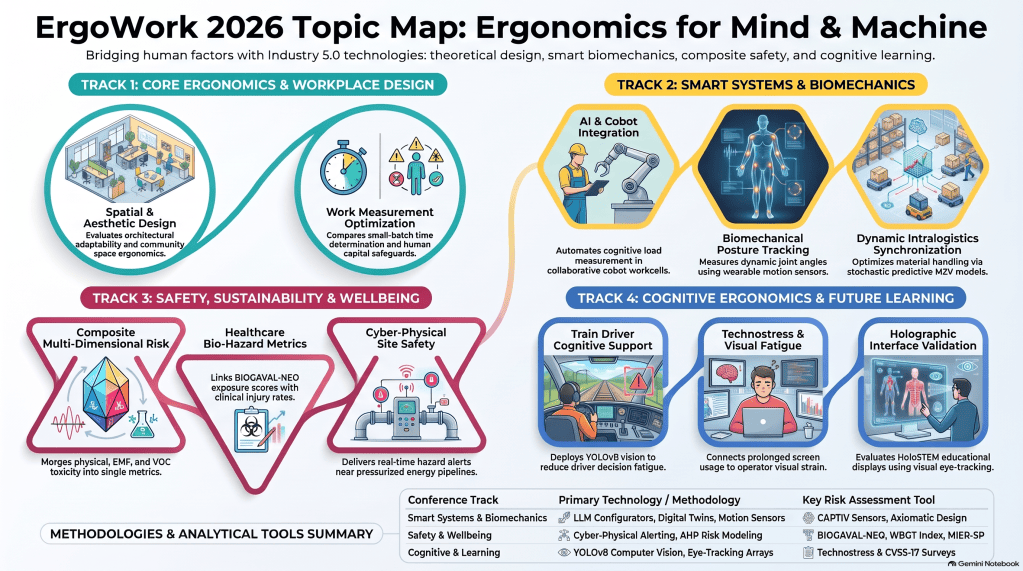
[Insert the ErgoWork 2026 Topic Map here. Caption: “An AI-assisted synthesis of selected research themes from the ErgoWork 2026 programme.”]
A question from the opening workshop stayed relevant across both days: if we change who does the work, how do we make sure people can still learn to do it, understand it well enough to challenge a recommendation, and shape the outcome? The conference offered practical ways to address it: compare different allocations of work, examine how people interpret information, and include human competence and control when assessing whether a system is resilient.
Thank you to all the speakers, panellists, authors and participants who contributed to the discussion, and to GreenForest and Politehnica University of Timișoara for hosting the two days.
View the full conference programme · Watch the Teleuniversitatea Timișoara report

